

Last Updated: November 5, 2026
Quick Summary
A youth ministry clothing closet launches in about twelve weeks by splitting the work into three phases: vision and team in weeks 1-4, space and supplies in weeks 5-8, and collect and open in weeks 9-12. Name one closet leader, secure written approval from church leadership, and run a soft launch with five to ten known families before opening to the public.
- Recruit a ministry team of five to eight adults plus a teen crew of four to six students.
- Pick a lockable room with space for two clothing racks and two folding tables.
- Wash every donated item before it reaches a rack, with no exceptions.
- Request adult small through adult extra-large sizes, since teens rarely fit children's sizes.
- Keep socks, underwear, and sports bras new and in original packaging.
Table of Contents
- Why a Youth Ministry Clothing Closet Matters
- Planning Your Church Clothes Closet: A Step-by-Step Launch Timeline
- Clothing Closet Donation Guidelines Every Ministry Needs
- What to Stock: Age-Appropriate Inventory for Teens and Kids
- Church Clothing Closet Organization: Racks, Bins, and Labels That Work
- Protecting Privacy and Dignity for Student Shoppers
- Launching Your Youth Ministry Clothing Closet This Season
- Frequently Asked Questions
Why a Youth Ministry Clothing Closet Matters
A youth ministry clothing closet is a dedicated space where students and families take home free clothing with dignity, no questions asked and no cost.
Here is what most guides get wrong: they treat a closet as a storage problem. It is not.
Closets serve children, students, and families in need in three ways:
- Emergency clothing for kids who cannot wait for a store run
- School outfits so students show up ready to learn
- Seasonal gear like coats, winter boots, and rain gear
U.S. Department of Education guidance on supporting students in need
Keep reading, and we will walk you through a full launch timeline, donation rules, and the safeguards that protect students.
Planning Your Church Clothes Closet: A Step-by-Step Launch Timeline
A church clothes closet can launch in about twelve weeks if you split the work into three phases and assign a named owner to each deliverable. The timeline below keeps volunteers focused and prevents the burnout that kills closets in year one. Ministries that write down a sequence tend to finish setup in one season, while those that wing it can stall after the first donation drive.
Here is the plan we would follow:
| Phase | Timeframe | Main Goal | Key Output |
|---|---|---|---|
| Vision and team | Weeks 1-4 | Build support and secure approvals | Named leader, core team, written approval from church leadership |
| Space and supplies | Weeks 5-8 | Get the room ready | Lockable room, racks, bins, startup budget |
| Collect and open | Weeks 9-12 | Stock, test, and launch | Sorted inventory, soft-launch feedback, first public open day |
Weeks 1-4: Cast the Vision and Recruit a Team
Start with a one-page pitch to your church leadership and youth parents. Faith-based volunteer ideas help here, since teens often serve best when the ask is concrete and time-boxed. Faith-based volunteer ideas help them recruit teens and adults to staff and run the closet.
Use the first month to secure written approval for three things: the room, the donation drop-off window, and the distribution schedule. A common pattern is for a closet to launch without leadership sign-off, then get paused when a scheduling conflict surfaces. Get the approval in writing and store it with your volunteer handbook.
Weeks 5-8: Secure Space, Budget, and Supplies
Pick a room with a door that locks, enough floor space for two clothing racks and two folding tables, and access to a sink or restroom. Build a simple startup budget covering racks, hangers, shelves, storage bins, labels, and a basic first-aid kit. Ask for donations of supplies before cash, and keep a written list of what you still need so donors can claim specific items.
Set up the room in zones during this phase: hanging racks along one wall, folding tables in the center, shelving for bins on the opposite wall, and a private fitting area with a curtain or door. Label every zone before the first donation arrives so volunteers sort into the right place from day one.
Weeks 9-12: Collect, Sort, and Open the Doors
Run a two-week collection drive with a published list of accepted items and a drop-off window that does not overlap with youth group pickup. Sort by size and gender, wash every item before it hits the rack, and set aside anything stained or torn for redirect.
Watch out: opening to the whole community before the soft launch means your first impression is a sorting day, not a shopping day. Test with a small group first, then scale.
Clothing Closet Donation Guidelines Every Ministry Needs
Clear donation guidelines are the difference between a stocked closet and a dumping ground. Write your rules down, post them, and hand them to every donor. Most guides stop at "accept gently used clothing," but a youth ministry closet needs rules that account for teen sizes, privacy, and fair access.
A common mistake is accepting everything. Set firm limits:
- Accept: gently used clothing in current styles, clean and folded, with sizes clearly marked
- Wash first: every item, no exceptions, before it reaches a rack
- Skip: stained, torn, or worn-out items, and anything with visible school logos or team names that could identify a student
- Redirect: items you cannot use go to a vetted donation center
Watch out: if you accept broken items "to be polite," volunteers spend hours sorting trash and morale drops fast.
Youth-Specific Donation Rules
Teens need sizes and styles that general clothing drives rarely prioritize. Add these rules to your donor list:
- Teen sizes first: request adult small through adult extra-large, plus juniors and young men's cuts, because middle- and high-school students rarely fit children's sizes
- Basics in new condition: socks, underwear, and sports bras should be new and in original packaging
- Shoes and boots: pair them, check tread, and skip anything with heavy wear
- Seasonal timing: collect coats and boots in early fall, not January, so students have them before cold weather
Eligibility, Access, and Referral Policies
Decide who can shop and how often before you open. A simple policy keeps distribution consistent and avoids stigma:
- Eligibility: students and families connected to your ministry or referred by a partner school, church, or social service agency
- Distribution limits: a set number of items per student per season, such as one coat, two tops, two bottoms, and one pair of shoes
- Referral pathway: a short form or phone call from a partner organization, with no income documentation required
- Confidential requests: a private request option for students who cannot come in person, fulfilled by a trained volunteer
Privacy and Safeguarding Rules for Donors and Volunteers
Donors should never see shopper names, and volunteers should never share a student's situation. Add these to your posted guidelines:
- No sign-in sheets with names visible to other shoppers
- No photos of shoppers or the distribution area
- Two-adult rule for any minor in a fitting area
- A named volunteer who handles incidents and keeps a written log
For donor-facing instructions, a step-by-step guide to donating clothes to charity helps your congregation know exactly what to do. When items do not fit the closet, learn how to find reputable clothing donation centers so nothing lands in a landfill. And for church accounting, organizing charitable clothing donation records keeps donors and your treasurer on the same page.
What to Stock: Age-Appropriate Inventory for Teens and Kids
Age-appropriate inventory means stocking what students actually wear, not what adults think they should wear. Teens avoid clothes that feel dated or preachy, and they will skip the closet entirely if the racks look like a lost-and-found bin.
Stock these categories:
- Tops: shirts, sweatshirts, plain tees in current fits
- Bottoms: jeans, joggers, shorts
- Outerwear: jackets, coats, rain gear
- Basics: socks, underwear, shoes, winter boots
- Seasonal: rotate stock each quarter
Size labels matter as much as style. Sort by gender and size, and keep a small supply closet of new basics.
Church Clothing Closet Organization: Racks, Bins, and Labels That Work
Good church clothing closet organization comes down to three tools: clothing racks, storage bins, and labels. Set them up right once, and weekly restocking takes minutes instead of hours.
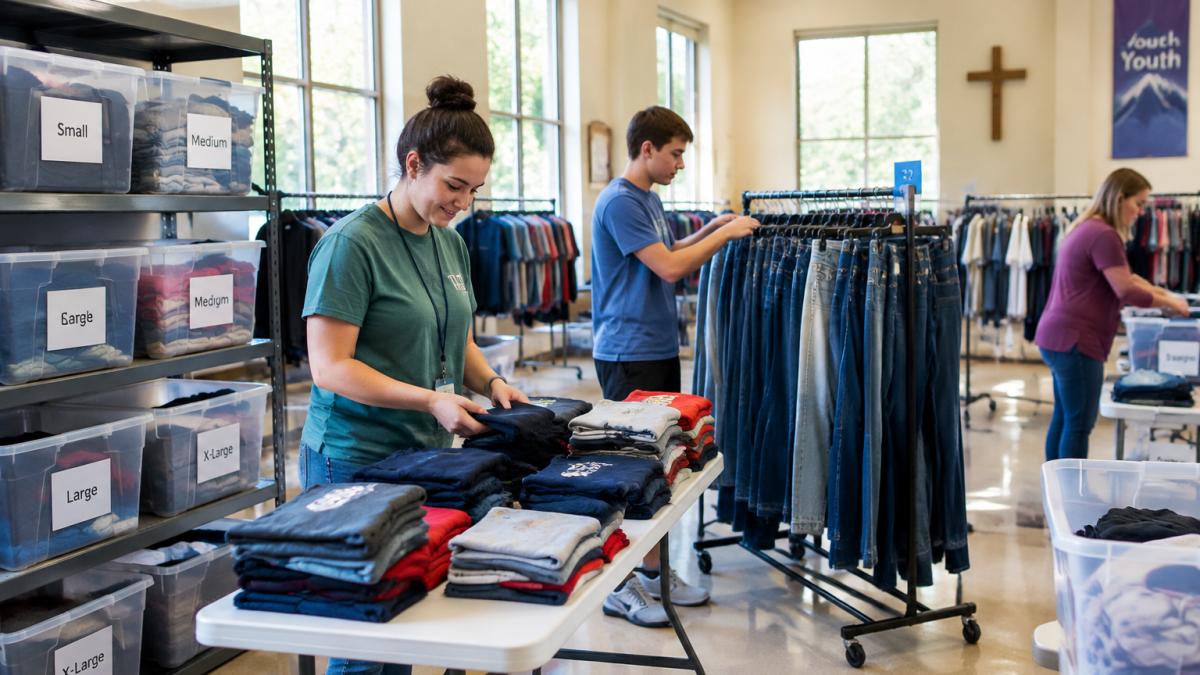
A common mistake is skipping the privacy section. Student shoppers share personal details, and volunteers need clear boundaries.
Protecting Privacy and Dignity for Student Shoppers
Privacy and dignity are not extras. They are the reason students come back.
Build these safeguards in from day one:
- No sign-in sheets with names visible to others
- Private fitting space with a curtain or door
- Trained greeters who ask nothing about income
- Two-adult rule for any minor in a fitting area
- No photos of shoppers, ever
A respectful dress code policy for your youth group helps you set clear expectations for what is accepted and worn, and it signals that the closet takes students seriously.
Watch out: posting photos of "closet day" on social media can expose a student's family situation. Ask permission or skip it.
Launching Your Youth Ministry Clothing Closet This Season
Launching is the easy part. Sustaining is where most closets fail. Plan for year-round replenishment before your first open day, and line up two partner churches or a local donation center for steady stock.
Measure what matters:
- Number of students served each month
- Most-requested sizes and gaps
- Volunteer hours logged
- Items donated versus items used
FEMA guidance on donating responsibly after needs arise
You can also give your teen team something to wear while they serve. Our Unisex Softstyle T-Shirt is 100% combed ringspun cotton with a tear-away label.

Frequently Asked Questions
What clothing should a youth ministry closet stock for teens?
Stock items teens actually wear to school and church: plain and graphic tees, jeans, sweatshirts, hoodies, jackets, and coats, plus socks, underwear, and shoes in current sizes. Add seasonal pieces like rain gear and winter boots before cold months. Skip anything stained, torn, or out of style. Faith-inspired tees from brands like IGIT Apparel (starting at $23.50) can also give students something new and encouraging to wear, and each purchase helps fund youth ministries.
How do you start a clothing closet at a church?
Start with a planning team and a clear purpose statement, then secure a room with shelving and rack space. Set donation guidelines, collect gently used clothing, and sort by size and gender before opening day. Recruit and train volunteers using a simple handbook, and set regular open hours. A 12-week launch timeline keeps the work manageable: four weeks to cast vision, four to secure space and supplies, and four to collect, sort, and open.
How can a church clothing closet protect teens' privacy and dignity?
Let students shop without being asked why they need clothes, avoid publicizing names or family situations, and offer private fitting areas. Use discreet bags instead of clear ones, and train volunteers to greet every guest the same way. Keep sign-in information minimal and stored securely. Dignity also means stocking sizes and styles teens actually want, so they leave with clothes they feel good wearing rather than items that mark them as receiving charity.
How often should a youth ministry clothing closet be open?
Most church clothes closets open one or two days per month, plus by appointment for emergencies like a sudden growth spurt, a house fire, or a family in crisis. Monthly open hours give volunteers time to sort donations, restock shelves, and keep inventory organized between distributions. Announce hours through the church bulletin and youth group leaders, and keep an emergency contact so families can request clothing outside regular times.
Building a closet takes twelve weeks. Keeping it stocked, staffed, and dignified takes a plan. IGIT Apparel exists to fund the youth work behind rooms like this, with faith-inspired clothing for men, women, and kids, free shipping, and secure payments. Get started with IGIT Apparel and wear your faith with purpose while your closet changes lives.
