

Table of Contents
- Step 1: Confirm 501(c)(3) Status Before You Donate Any Clothing
- Step 2: Digital Verification of Local Donation Bins and Drop-Off Sites
- Step 3: How to Value Clothing Donations for Taxes Using IRS Guidelines
- Step 4: Charitable Donation Receipt Requirements You Must Meet
- Step 5: Document and Track Your Charity Apparel Donations Year-Round
- Common Mistakes to Avoid When Verifying Clothing Donations
- How Faith-Based Apparel Purchases Can Extend Your Charitable Impact
- Conclusion
Last Updated: August 3, 2026
Knowing how to verify charity apparel donations is more important than most donors realize. This guide from IGIT Apparel breaks down every step you need to protect your tax deduction, confirm a charity's legitimacy, and document your clothing donations correctly. Many donors assume the receipt they receive is all they need, it is not. Below, we'll show you exactly how to confirm 501(c)(3) status, value your items the way the IRS expects, spot fraudulent collection operations, and track everything year-round.
Here's what most guides get wrong: they treat charity verification as a one-time checkbox rather than a process with several distinct steps. Miss one, and you risk losing your charitable deduction entirely.
Step 1: Confirm 501(c)(3) Status Before You Donate Any Clothing
Verifying a charity's tax-exempt status is the foundation of the entire process. A charity must hold active 501(c)(3) status with the IRS for your clothing donation to qualify as a tax-deductible contribution. A common mistake is assuming that a charity's name sounds legitimate or that it operates a physical thrift store, which automatically makes it a qualifying non-profit. Neither assumption is safe.

Using the IRS Tax-Exempt Organization Search Tool
The IRS Exempt Organizations Select Check tool is the authoritative source for confirming a charity's status. According to IRS Tax Exempt Organization Search, you can search by organization name, EIN, or location and see whether a charity currently holds active exempt status.
Steps to use the tool:
- Go to the IRS Exempt Organizations Select Check page
- Enter the organization's legal name or Employer Identification Number
- Filter by state to narrow results for local charities
- Confirm the status shows "Active" under the "Pub 78 Data" column
- Note the organization's EIN for your donation records
The search takes under two minutes. If the charity does not appear, or if its status shows as revoked, do not donate with the expectation of a tax deduction.
Differentiating Between Thrift Stores and Qualifying Non-Profits
A thrift store is a retail outlet; a non-profit organization is a legal entity. Many qualifying charities operate thrift stores as a revenue arm, but the thrift store itself is not the tax-exempt entity. When you donate clothing, you are donating to the organization, not the store. Always verify the legal entity, not the storefront.
Step 2: Digital Verification of Local Donation Bins and Drop-Off Sites
Unattended donation bins may belong to a legitimate non-profit, a for-profit textile recycler, or a fraudulent operation. You cannot tell from the bin itself. Digital verification is essential.
Red Flags of Fraudulent Clothing Collection Operations
Fraudulent clothing collection operations use charity-adjacent language without holding 501(c)(3) status. According to FTC consumer guidance on charity fraud, watch for these warning signs:
- The organization name closely resembles a well-known charity but is slightly different
- No EIN is listed on the bin, website, or printed materials
- The bin displays no physical address for the organization
- Requests for cash alongside clothing donations
- High-pressure language urging immediate donation
- No acknowledgment receipt process described anywhere
If you cannot find the organization in the IRS Exempt Organizations database, do not claim a deduction.
Mobile App Tracking for Donations
Apps like ItsDeductible (developed by Intuit/TurboTax) allow donors to photograph items, assign fair market value based on current thrift store prices, and generate a year-end summary report. For donation bin verification, search the organization's name on your state's charity registration database. Most states require charities to register before soliciting donations, and those registries are searchable online.
Step 3: How to Value Clothing Donations for Taxes Using IRS Guidelines
Fair market value is the number the IRS actually cares about. Many donors overvalue their clothing donations, which is one of the most common triggers for additional scrutiny on itemized returns.
Fair market value is the price a willing buyer would pay a willing seller when neither is under pressure to complete the transaction. For used clothing, this is almost always significantly lower than original retail value.
Fair Market Value vs. Retail Value: What the IRS Actually Wants
According to IRS Publication 561 on determining value of donated property, the fair market value of used clothing is the price it would sell for in a thrift store, not what you paid for it originally. A jacket that cost $150 new and is in good condition might sell at a thrift store for $12 to $20. That range, not $150, is your deductible amount.
Clothing Valuation Reference Table
Use this table as a starting reference for common clothing categories. These ranges reflect typical thrift store prices for items in good condition.
| Clothing Item | Low FMV Estimate | High FMV Estimate | Condition Assumed |
|---|---|---|---|
| Men's dress shirt | $4 | $9 | Good |
| Women's blouse | $3 | $8 | Good |
| Jeans (adult) | $6 | $14 | Good |
| Children's jacket | $5 | $12 | Good |
| Adult winter coat | $10 | $25 | Good |
| Dress / formal wear | $8 | $20 | Good |
| Sneakers / athletic shoes | $6 | $15 | Good |
| Sweater | $4 | $10 | Good |
Items in poor condition are worth less than these ranges. Items in excellent or like-new condition may reach the high end.
Step 4: Charitable Donation Receipt Requirements You Must Meet
The IRS has specific written acknowledgment rules, and failing to meet them can disqualify your deduction entirely, even if the charity is legitimate and your valuation is accurate.
What Your Written Acknowledgment Must Include
For any single clothing donation with a claimed value of $250 or more, you must obtain a written acknowledgment from the charity. A generic "thank you for your donation" does not meet this standard.
A compliant written acknowledgment must include:
- The charity's legal name
- The date of the donation
- A description of the donated items (not a dollar value assigned by the charity)
- A statement confirming whether any goods or services were provided in exchange for the donation
- If goods or services were provided, their estimated value
Keep this acknowledgment with your tax records before you file your return.
Understanding IRS Form 8283 for Non-Cash Contributions Over $500
Form 8283 is required for non-cash charitable contributions that exceed $500 in total for the tax year. Section A covers donations valued between $501 and $5,000; you complete this section yourself using your own fair market value assessment. Section B covers donations valued above $5,000, which generally require a qualified appraisal.
Key Form 8283 requirements:
- Attach to your federal tax return (Form 1040)
- List each organization separately if you donated to multiple charities
- Include the date of contribution and description of property
- For Section A, no appraisal is required, but your valuation method must be defensible
If you donated multiple bags across the year to the same or different organizations, the totals add up. Track everything.
Step 5: Document and Track Your Charity Apparel Donations Year-Round
Donation tracking is where most people's good intentions fall apart. The fix is a simple system maintained throughout the year.
Building a Donation Inventory Checklist
A donation inventory checklist is a running log of every item you donate, its condition, and its assigned fair market value. A spreadsheet or printed form works.
Your checklist should capture:
- Date of donation
- Organization name and EIN
- Physical address of drop-off location
- Description of each item donated (type, brand, size, condition)
- Assigned fair market value per item
- Total value of the donation batch
- Method of delivery (drop-off, scheduled pickup, donation bin)
- Written acknowledgment received (yes/no)
- Photo documentation taken (yes/no)
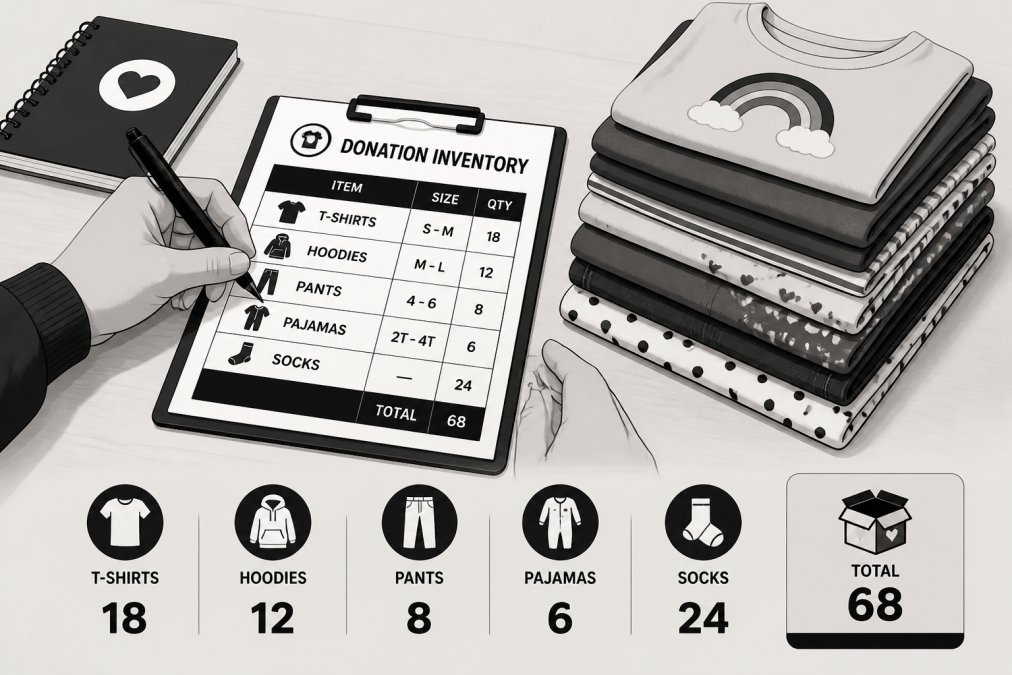
Photograph each bag or box of items before you drop it off. A quick photo on your phone with a timestamp provides visual documentation if questions arise later. Store the photos in a dedicated folder alongside your written acknowledgments and Form 8283 copies.
Common Mistakes to Avoid When Verifying Clothing Donations
Donating to unattended bins without checking exempt status. Many bins are operated by for-profit textile companies, and no deduction applies.
Using original purchase price as the donation value. The IRS wants fair market value, which for used clothing is thrift store resale price.
Missing the written acknowledgment threshold. Any single donation valued at $250 or more requires written acknowledgment before you file.
Failing to file Form 8283 when required. If your total non-cash charitable contributions exceed $500 for the year, Form 8283 is mandatory.
Donating items in poor condition and claiming good-condition values. The IRS expects condition-adjusted valuations.
How Faith-Based Apparel Purchases Can Extend Your Charitable Impact
Understanding charity verification is one side of the equation. The other is choosing where your charitable dollars go in the first place.
For mission-driven consumers, particularly those in the Christian community, the distinction between a purchase and a donation is narrowing. Brands like IGIT Apparel operate on a model where buying faith-inspired clothing directly funds Christian ministries and youth initiatives. Every purchase channels resources to organizations supporting teenagers and young believers.
This matters for donors who want to support Christian youth ministries but find the charity verification process complex. A mission-driven purchase through a transparent brand is a different mechanism than a tax-deductible charitable donation, but the underlying intent, supporting meaningful work, is the same.
For those who do make direct clothing donations to qualifying non-profits, the steps in this guide apply fully. Verify 501(c)(3) status, document your items, value them at fair market value, and retain your written acknowledgment. Faith-based giving, whether through direct donation or mission-aligned purchasing, benefits from the same discipline: verify, document, and track.
Conclusion
| Step | Key Action | IRS Requirement |
|---|---|---|
| Confirm 501(c)(3) status | Use IRS Exempt Organizations Search | Required for deductibility |
| Verify drop-off sites | Check bin operator's exempt status | Prevents fraudulent donations |
| Value items at FMV | Use thrift store price, not retail | IRS Publication 561 standard |
| Obtain written acknowledgment | Get compliant receipt for $250+ donations | Required before filing |
| File Form 8283 | Required for non-cash donations over $500 | Attach to Form 1040 |
| Maintain year-round records | Photo + inventory checklist | Supports audit defense |
Many donors lose deductions not because they gave to the wrong organization, but because they skipped a documentation step they did not know was required. The steps above cover everything the IRS expects when you verify charity apparel donations. For those looking to extend their charitable impact beyond individual donations, IGIT Apparel offers faith-inspired clothing for men, women, and kids, with every purchase directly supporting Christian youth ministries. With free shipping and secure payments, it is a practical way to make your values visible while contributing to work that matters. Shop now and wear your faith with purpose.
Frequently Asked Questions
How do I check if a charity collecting clothing donations is legitimate?
Start by searching the organization's name on the IRS Exempt Organizations Select Check tool at apps.irs.gov. A legitimate charity must hold 501(c)(3) status for your donation to qualify as tax-deductible. You can also cross-reference the organization on charity accountability platforms like Charity Navigator or GuideStar. If a collection bin or solicitation lacks a registered organization name, a physical address, or verifiable contact information, treat that as a red flag before donating.
How do I know if my clothing donation is tax-deductible?
Your clothing donation is tax-deductible only when it goes to a qualifying 501(c)(3) exempt organization, you itemize deductions on your federal tax return, and the clothing is in good used condition or better. You must also obtain a written donation receipt from the charity. If your total non-cash charitable contributions exceed $500 in a tax year, you are required to complete IRS Form 8283 and attach it to your return. Keep your donation inventory and receipt records for at least three years in case of an IRS audit.
What documents do I need for clothing donation tax deductions?
The IRS requires a written acknowledgment from the charity for any donation valued over $250. This receipt must include the organization's name, the date of the donation, a description of the items, and a statement confirming no goods or services were given in exchange. For total non-cash contributions exceeding $500, attach IRS Form 8283 to your return. For donations valued above $5,000, a qualified appraisal is generally required. Photograph your items and keep a detailed donation inventory as supporting documentation.
What are the red flags of a fraudulent clothing collection bin?
Watch for bins that display vague charity names without a verifiable EIN or physical address, use emotional imagery without disclosing how proceeds are distributed, or list only a phone number with no web presence. Some for-profit textile recyclers place bins that look like charity drop-offs but are not registered non-profits. Always search the organization name in the IRS tax-exempt organization search before assuming your donation qualifies. Legitimate charities are transparent about their 501(c)(3) status and how donated clothing funds their mission.
Can I use a mobile app to track and verify my charity apparel donations?
Yes. Apps like ItsDeductible (from Intuit) allow donors to log clothing items, assign fair market value based on thrift store price comparables, and generate donation summaries for tax filing. Some charity platforms also offer digital receipts through their own apps. Keeping a running log throughout the year prevents scrambling at tax time and gives you a clear donation inventory if the IRS requests substantiation. Pair app records with physical or emailed receipts from the receiving organization for complete documentation.
How is fair market value determined for donated clothing?
The IRS defines fair market value as the price a willing buyer would pay a willing seller, with neither under pressure to complete the transaction. For clothing, this typically means what the item would sell for at a local thrift store, not the original retail price. Published valuation guidelines from organizations like the Salvation Army provide item-by-item FMV ranges as a starting reference. Condition matters: only clothing in good used condition or better qualifies for a charitable deduction under IRS rules.
This article was written using GrandRanker