

Table of Contents
- Define Your Fundraising Goal and Timeline
- Youth Ministry Fundraiser Ideas That Actually Work
- Build Your Fundraising Committee and Recruit Volunteers
- Church Fundraising Best Practices for Long-Term Success
- Youth Group Fundraising Templates and Planning Tools
- Youth Ministry Outfit Ideas for Church Events and Promotion
- Promote Your Fundraiser and Maximize Community Engagement
- Legal Compliance and Tax Considerations
Last Updated: August 18, 2026
Define Your Fundraising Goal and Timeline
Without a specific fundraising target and timeline, volunteers lose momentum and donors don't know if they're helping. Define your goal down to the dollar and break it into milestones: 25% by month one, 50% by month two. A six-week fundraiser builds urgency without burning out volunteers. Avoid summer and holidays when giving fatigue sets in; spring and fall typically work best.
Document your goal, timeline, and the specific mission it funds. Share this with your fundraising committee before recruiting volunteers. Transparency builds trust and attracts committed supporters.
Youth Ministry Fundraiser Ideas That Actually Work
The best fundraiser ideas are easy for youth to execute and generate real revenue without massive upfront investment.
Service-Based Fundraisers
Service-based fundraisers let youth demonstrate their value to the community while raising money and building relationships.
Yard work and seasonal services address real community needs. Fall leaf cleanup, spring yard cleanup, and snow removal in winter are reliable. A team of five youth working a Saturday morning can generate $200-400. Schedule around peak demand seasons and promote through your church bulletin and local networks.
Car washes work if you add a twist. Host at high-traffic locations, add a bake sale table or raffle, and make it an event. Standalone car washes typically generate $150-300 for four hours; combined with other elements, you can double that.
Babysitting and pet-sitting services appeal to busy families. Create a sign-up sheet listing available youth, rates, and contact information. Distribute through your church network and local Facebook groups. Youth typically charge $12-18 per hour for babysitting, $15-25 per pet-sitting visit.
Product Sales and Events
Custom apparel sales are particularly effective for youth ministry fundraisers. IGIT Apparel offers designs that appeal to Gen Z, contemporary styles expressing faith. When youth wear the apparel themselves at school and events, it becomes organic promotion. Pieces like the Pointing Kids To Jesus tee ($28.50) or GOD IS MY ROCK ($24.50) sell because young people actually want to wear them. Order in bulk, mark up 30-50%, and keep the difference. Selling 50 shirts generates $300-700 in profit.


Fundraising dinners or pancake breakfasts work with strong volunteer support. Host at your church, promote through the community, and price reasonably ($10-15 per plate). A well-executed dinner generates $500-1,000 if you keep food costs low and volunteer labor high. Tell the mission story, people give when they know where their money goes.
Movie nights or game tournaments combine fundraising with community engagement. Charge $5-10 entry, sell concessions at marked-up prices, and create an event that feels like fun, not a sales pitch. Youth groups typically generate $300-500 from a well-promoted evening.
Digital and Peer-to-Peer Campaigns
Peer-to-peer fundraising platforms like GoFundMe, Givebutter, or Facebook Fundraisers let each youth create a personal page. They share with family, friends, and social networks. Youth typically raise $200-500 each when actively promoting. A group of 10 youth can reach $2,000-5,000 with minimal overhead.
Email campaigns to your church's donor database work with a compelling story. Write one email explaining your goal, the mission, and how donations help. Include a donation link. Many churches see a 5-10% response rate.
Social media campaigns use where young people already spend time. Create a hashtag, post progress updates, share stories of impact, and ask followers to donate or share. TikTok, Instagram Reels, and YouTube Shorts work well because youth can create authentic, behind-the-scenes content.
Text-to-give campaigns reach supporters through their phones. Partner with a platform letting donors text a keyword to a number and complete a donation. Promote the text code at church, on signage, and through email.
Build Your Fundraising Committee and Recruit Volunteers
A youth ministry fundraiser lives or dies based on who executes it. You need a fundraising committee, a mix of adult leaders and engaged youth, and a clear volunteer recruitment strategy.
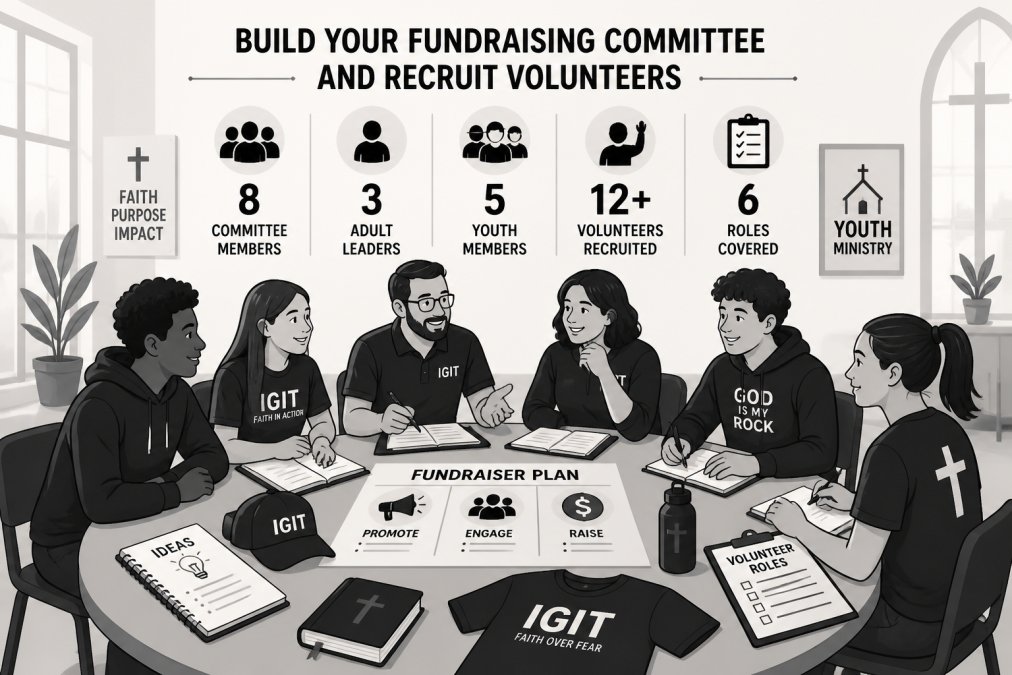
Your fundraising committee should include 3-5 people: one adult coordinator, 1-2 other adults for support, and 2-3 influential youth who become ambassadors. Meet monthly to plan, track progress, and troubleshoot.
Recruit volunteers with specificity. Don't say "we need help with our fundraiser." Say "we need five people for the car wash on Saturday from 9am-1pm." Specific asks get yes answers. Use multiple recruitment channels: announce in youth group meetings, post on social media, send emails to parents, and add sign-up sheets to your church bulletin.
Track volunteer hours and impact. When someone completes a shift, thank them specifically. "Sarah and Marcus sold 23 shirts today, that's $345 toward our mission trip" is more motivating than generic thanks. For large fundraisers, assign a volunteer coordinator to manage sign-ups, send reminders, coordinate logistics, and handle day-of problems.
Church Fundraising Best Practices for Long-Term Success
Sustainable youth ministry fundraising builds systems that generate consistent revenue and community goodwill over time.
First, diversify your revenue streams. Relying on one fundraiser creates risk. Multiple streams, service-based work, apparel sales, ongoing donations, mean one underperforming event doesn't derail your goal.
Second, build donor relationships. Track who gives, how much, and when. Thank them personally with handwritten notes from youth. Invite major donors to events so they see impact. Donors who feel connected give repeatedly.
Third, communicate progress transparently. Share updates on where you stand toward your goal. "We've raised $3,200 of our $5,000 target, 64% there" motivates giving. Post progress on your church bulletin, in emails, and on social media.
Fourth, celebrate milestones. When you hit 25%, 50%, 75%, acknowledge it with small celebrations, testimonies, or volunteer appreciation. These moments sustain energy.
Fifth, connect giving to impact. Tell the story: "This money will send 12 youth to serve alongside our sister church in Kentucky for a week. They'll rebuild homes, lead vacation Bible school, and build relationships that will shape their faith."
Youth Group Fundraising Templates and Planning Tools
Templates eliminate guesswork and keep your team organized.
Fundraising Plan Template
| Element | Details |
|---|---|
| Goal Amount | $_____ |
| Mission/Purpose | _____ |
| Target End Date | _____ |
| Committee Members | _____ |
| Primary Fundraiser(s) | _____ |
| Secondary Fundraiser(s) | _____ |
| Monthly Milestone (25%) | $_____ by _____ |
| Monthly Milestone (50%) | $_____ by _____ |
| Monthly Milestone (75%) | $_____ by _____ |
| Target Completion | $_____ by _____ |
| Communication Plan | Email / Social / Bulletin / In-Person |
| Volunteer Recruitment Strategy | _____ |
Volunteer Sign-Up Checklist
- Event name and date
- Time commitment (start and end time)
- Location
- Specific role(s) needed
- Contact person for questions
- Sign-up deadline
- Reminder sent one week before
- Reminder sent two days before
- Thank you message sent after event
Fundraiser Event Checklist
- Date and time confirmed
- Location reserved
- Permits or approvals obtained (if needed)
- Volunteers recruited and confirmed
- Supplies purchased or arranged
- Promotion launched (4 weeks before)
- Promotion repeated (2 weeks before)
- Final reminder sent (3 days before)
- Setup plan documented
- Contingency plan for bad weather or low turnout
- Payment processing method tested
- Post-event thank you plan created
Youth Ministry Outfit Ideas for Church Events and Promotion
What youth wear to your fundraiser matters. Coordinated apparel builds team identity, makes your group visible, and can become part of your fundraising strategy.
For volunteer shifts, consider matching t-shirts. IGIT Apparel's designs work perfectly because youth actually want to wear them. A group wearing the same faith-inspired shirt creates visual unity and makes your fundraiser feel organized. The Is God Real tee ($24.50) or Unisex Softstyle T-Shirt ($24.50) are quality pieces that look sharp in photos and video.

When selling apparel as part of your fundraiser, have youth wear pieces from your inventory. Real people wearing real clothes is the best advertisement. For mission trips or service events, branded apparel creates accountability and visibility while making it easy to spot youth in a crowd and creating lasting memories.
Promote Your Fundraiser and Maximize Community Engagement
A well-executed fundraiser fails silently if nobody knows about it. Promotion is half the battle.
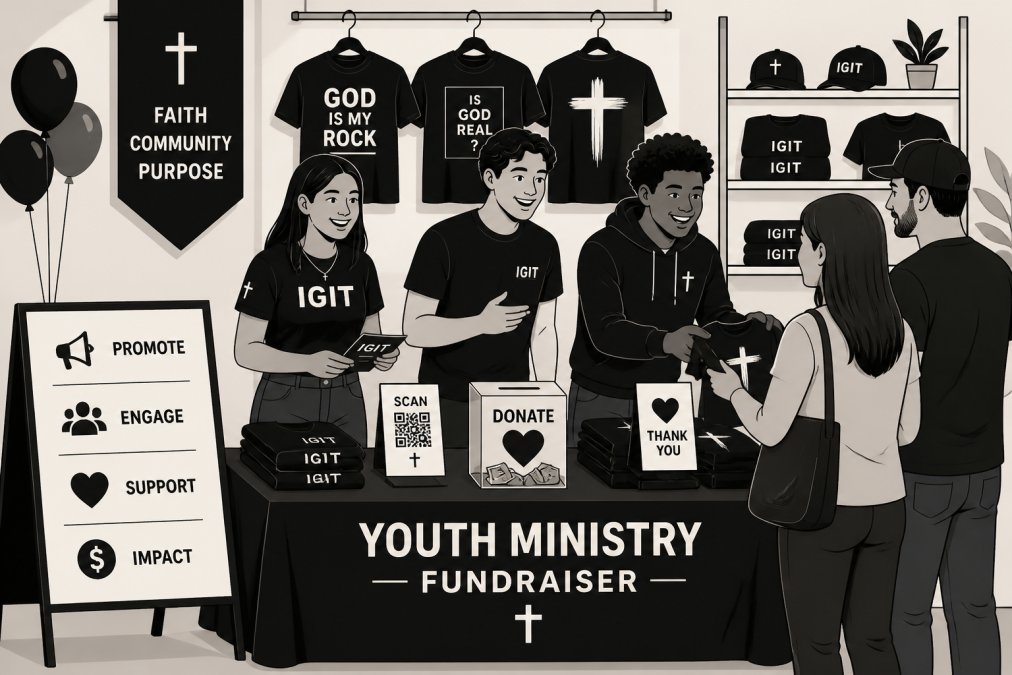
Start promotion at least four weeks before your event. This gives time to build awareness through multiple channels.
In-person promotion happens at church. Announce from the pulpit, add details to your bulletin, post flyers in high-traffic areas, and talk about it in youth group meetings. Personal invitations from youth to adults they know work surprisingly well.
Email campaigns reach families directly. Send an email four weeks out introducing the fundraiser and goal. Send another two weeks out with participation details. Send a final reminder one week before. Include a clear call to action and provide a link for online giving or apparel sales.
Social media promotion leverages where your youth already are. Post on your youth group's Facebook, Instagram, and TikTok. Share behind-the-scenes content, volunteer spotlights, progress updates, and impact stories. Use a consistent hashtag. Ask youth to share posts to their personal accounts.
Community outreach expands beyond your church. Post flyers at local businesses, coffee shops, and community centers. Reach out to local media for a story angle. Partner with neighboring churches or community organizations to cross-promote.
During your fundraiser, thank people publicly. Take photos and videos. Share real-time updates on social media. After the event, share results and post thank-you content featuring volunteers and donors.
Legal Compliance and Tax Considerations
Running a youth ministry fundraiser involves legal and tax responsibilities that protect your church and build donor confidence.
Tax-deductible donations are a major incentive for donors. If your church is a registered 501(c)(3) nonprofit, donations to your youth ministry fundraiser are typically tax-deductible. Donors should receive a written receipt stating the amount donated and confirming that no goods or services were provided in exchange. Keep records of all donations.
Sales tax applies to product sales. If you're selling apparel, baked goods, or other items, you may owe sales tax depending on your state and local regulations. Check with your state's department of revenue. Churches often have exemptions for certain activities, but this varies. Document your sales and keep receipts.
Permits and insurance may be required for certain fundraisers. A large event, car wash in a public space, or food service may require permits from your local government. Check with your city or county. Your church's insurance policy should cover youth group fundraising activities, but confirm this with your insurance provider.
Financial reporting keeps donors confident. Track all money raised and expenses. Report results to your church leadership and donors. Annual impact reports demonstrate stewardship and encourage repeat giving.
Child safety policies matter when youth are fundraising. If youth are going door-to-door, working in unfamiliar locations, or interacting with donors, establish clear safety guidelines. Youth should work in pairs or groups, never alone. Adults should supervise. Communicate the plan to parents.
According to IRS guidance on tax-exempt organizations, nonprofits must maintain detailed records of all fundraising activities and donor contributions.
Starting a youth ministry fundraiser requires clear goals, diverse revenue streams, strong volunteer recruitment, and consistent promotion. Combine multiple fundraising methods, service-based work, product sales like faith-inspired apparel, and digital giving, so one underperforming event doesn't derail your progress. Build relationships with donors, celebrate milestones, and always connect fundraising back to impact. When youth see their work matters and directly supports their mission, they stay engaged. When donors see transparency and stewardship, they give again.
IGIT Apparel makes apparel-based fundraising easier because designs actually appeal to young people. Rather than feeling obligated to buy, youth want to wear these pieces, promoting them naturally. Combined with service-based fundraisers and peer-to-peer campaigns, apparel sales create a sustainable fundraising strategy that builds community engagement and generates real revenue for your youth ministry.
Frequently Asked Questions
What are the most profitable youth ministry fundraiser ideas?
Service-based fundraisers like car washes and yard work tend to generate steady revenue with minimal upfront costs. Product sales, especially branded items and seasonal goods, often produce higher per-unit margins. Peer-to-peer fundraising campaigns and online donation platforms expand your reach beyond your immediate community. The most profitable approach combines multiple fundraiser types over time rather than relying on a single event. Track which fundraisers your youth group enjoys most, engagement drives participation, which directly impacts revenue.
How do you plan a successful youth ministry fundraiser?
Start by setting a specific financial goal and deadline. Form a fundraising committee with clear roles and responsibilities. Choose fundraiser ideas that match your youth group's skills and your community's needs. Create a detailed timeline, budget, and promotion strategy. Recruit and train volunteers before launch. Use a youth group fundraising template to track progress and expenses. Assign a point person to oversee daily operations. Finally, celebrate milestones with your team to maintain momentum throughout the campaign.
What legal considerations apply to church fundraisers?
Church fundraisers are typically tax-exempt if your organization holds 501(c)(3) status from the IRS. Donors can deduct contributions if your church is registered as a nonprofit. Keep detailed records of all funds raised and how they're spent, this supports both stewardship and tax compliance. Some states require permits for certain activities like food sales or raffles; check local regulations before launching. Ensure all volunteers understand they're representing your ministry and maintain appropriate conduct. Document that funds support your stated youth ministry mission, not personal use.
How can youth ministry apparel support fundraising efforts?
Branded apparel creates team unity and pride while generating revenue. Selling faith-inspired t-shirts, hoodies, or accessories gives supporters a tangible way to contribute while promoting your ministry. IGIT Apparel offers quality faith-based clothing starting at $24.50 that you can resell or use as fundraiser rewards. Wearing matching apparel at events increases visibility and professionalism. Apparel also serves as a lasting reminder of the fundraiser's impact, strengthening donor retention and community engagement with your youth ministry.
This article was written using GrandRanker