

Table of Contents
- Why Affordable Ethical Fashion Matters
- Affordable Sustainable Clothing Brands Worth Your Money
- How to Identify Ethical Clothing Brands Before You Buy
- Shopping Secondhand Ethical Fashion on a Real Budget
- Sustainable Wardrobe Tips That Cut Costs and Waste
- Verify Your Impact: Checking Where Your Money Actually Goes
- Building an Ethical Wardrobe Without Breaking the Bank
- Frequently Asked Questions
Last Updated: October 17, 2026
Why Affordable Ethical Fashion Matters
Ethical fashion doesn't have to drain your wallet. The belief that sustainable, fairly-made clothing is out of reach is one of fashion's biggest myths.
When you buy ethical clothing, your money supports real people: workers earn fair wages, communities thrive, and the environment takes less damage, no fortune required.
This guide breaks down affordable ways to shop for ethical fashion, which brands deliver quality without premium pricing, how to spot greenwashing, and how to make secondhand shopping faster and smarter.
Affordable Sustainable Clothing Brands Worth Your Money
Finding affordable sustainable clothing brands requires knowing what to look for.
Several brands deliver ethical clothing at reasonable price points. The notes below focus on what each brand actually discloses and where it typically lands on price:
- Everlane publishes cost breakdowns for many products and names the factories it uses; core tees and knits typically sit in the $30-$60 range, with outerwear higher
- Reformation uses deadstock and lower-impact materials and publishes an annual sustainability report; dresses and tops commonly fall in the $50-$150 band, so it is mid-range rather than entry-level
- IGIT Apparel combines faith-inspired designs with a mission-driven model, supporting youth ministries while keeping prices reasonable
The key difference from fast fashion? These companies invest in quality. A shirt that lasts two years costs less per wear than one that falls apart after five washes.
When evaluating affordable sustainable clothing brands, check material sourcing: organic cotton, recycled fabrics, natural dyes. Transparent brands often keep prices lower because they're not spending on deceptive marketing.
A five-minute verification checklist before you buy
Use this repeatable five-minute process to vet any brand, including ones not listed here:
- Find the factory list. Look for a supplier or factory page. Named factories with addresses are a strong signal; vague "partnered with ethical factories" language is not.
- Check certifications against the certifier's own directory. Fair Trade Certified, Global Organic Textile Standard (GOTS), and B Corp each maintain public lookup tools. A logo on a brand site means little if the brand does not appear in the certifier's database.
- Read the material claim closely. "Organic cotton" should specify a certification; "recycled" should say recycled what and from where. Unqualified adjectives are a yellow flag.
- Look for numbers, not adjectives. A credible impact or sustainability report includes figures, wage data, energy use, water savings, audit results. A page of stock photography and the word "conscious" is marketing.
- Check the return and repair policy. A brand confident in durability often offers repairs or a resale program. That policy is also a practical cost-saver for you.
Greenwashing phrases to slow down for
A few phrases appear so often in marketing that they have lost meaning. None of them is proof of bad practice on its own, but each should trigger the checklist above:
- "Eco-friendly" or "green" with no certification or metric attached
- "Conscious collection" or similar capsule names that imply ethics without defining them
- "Made with sustainable materials" without naming the material or its certification
The FTC's Green Guides set expectations for how environmental claims should be substantiated in marketing. You do not need to memorize them, just remember that a specific, checkable claim beats a poetic one every time.
How to Identify Ethical Clothing Brands Before You Buy
Identifying ethical clothing brands takes practice. Start by examining what a brand actually says versus what it implies, many use words like "eco-friendly" or "sustainable" without evidence.
Here's what to check:
- Supply chain transparency: Can you find out where clothes are made? Are factory names public? Do workers have fair wages documented?
- Material sourcing: Does the brand specify where cotton comes from? Do they use organic, recycled, or regenerated materials?
- Third-party certifications: Look for Fair Trade Certified, Global Organic Textile Standard (GOTS), or B Corp certification
A red flag appears when brands make big sustainability claims but provide no evidence. That's greenwashing.
Visit a brand's sustainability or impact page. If it doesn't exist, that's telling. If it exists but contains only vague language and no numbers, be skeptical.
Shopping Secondhand Ethical Fashion on a Real Budget
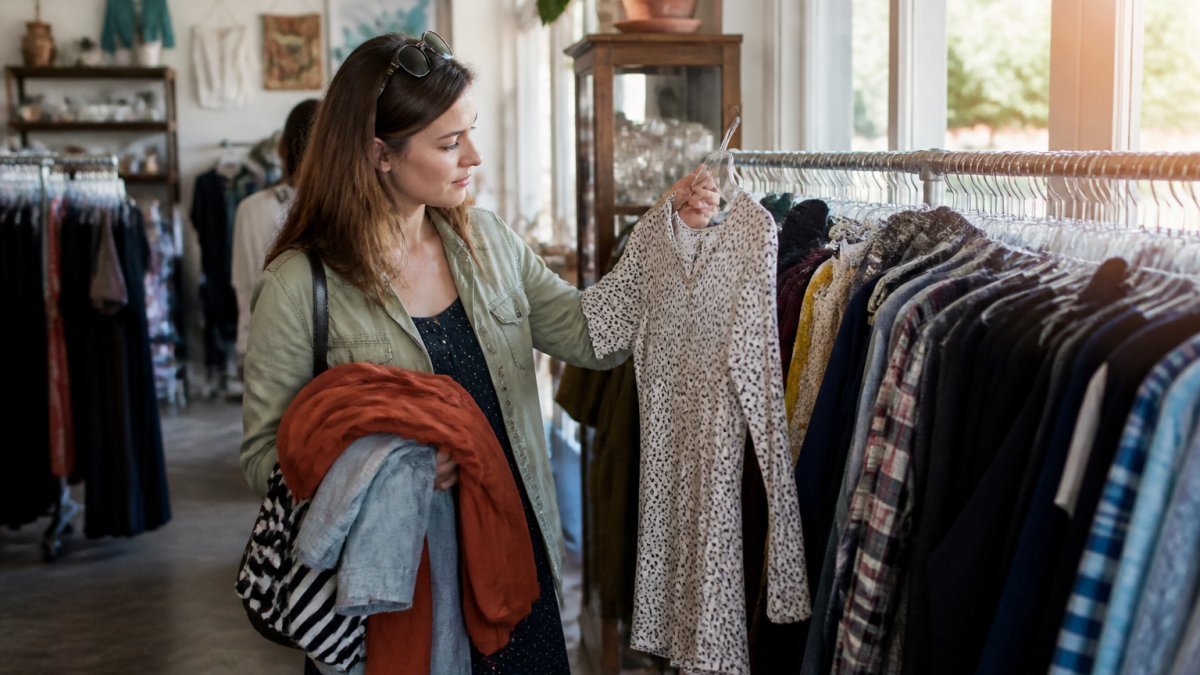
Secondhand shopping is the most affordable way to shop for ethical fashion. It eliminates manufacturing waste, extends garment life, and costs a fraction of retail. The challenge is finding quality pieces efficiently, and knowing which channel fits your budget, patience level, and verification needs.
Compare the channels before you commit
Here's how the main secondhand channels stack up on price, convenience, and how much you can verify before buying.
- Thrift stores (Goodwill, Salvation Army, local consignment): lowest prices, often under $10 per item. Convenience is low, inventory is unpredictable and sizing is hit-or-miss. Verification is minimal: you inspect the garment in person, but you rarely learn its history. Best for basics, layering pieces, and experimentation.
- Online resale platforms (Poshmark, Depop, Vinted, Mercari): the widest selection and the best filtering by size, brand, and condition. Prices land between thrift and brand resale, and shipping usually adds a flat fee. Verification is moderate, you rely on seller photos, measurements, and ratings. Best when you are hunting a specific item.
- Local marketplaces and community groups (Facebook Marketplace, neighborhood swaps, buy-nothing groups): no shipping on local pickup, and swaps can be free. Convenience is medium, you coordinate with individuals. Verification is low to moderate; you inspect in person but have little recourse if something is wrong. Best for free or near-free acquisitions and for offloading what you no longer wear.
A simple rule of thumb: the cheaper the channel, the more of your own time and judgment it demands. The more expensive the channel, the more verification is done for you.
A quality check that works in any channel
Whether you are standing in a thrift store or scrolling a resale app, run the same five-point inspection:
- Check the seams and stress points. Look at underarms, crotch seams, and pocket corners. Thinning or pulled threads there mean the garment is closer to failure than the photos suggest.
- Read the fiber content tag. Natural fibers and higher-quality blends tend to survive repeated washing better than cheap synthetics. The tag also tells you how to care for the piece.
- Look for pilling and fading at friction points. Collars, cuffs, and inner thighs show wear first.
- Confirm measurements, not sizes. Sizing varies by brand and era. Ask sellers for flat measurements (chest, waist, inseam) and compare them to a garment you already own.
- Ask about repairs and alterations. A missing button or a loose hem is a cheap fix; a broken zipper on a lined jacket is a bigger job. Price the fix before you buy.
One often-missed advantage: secondhand shopping lets you test brands before committing. Buy one piece from an ethical brand secondhand, see how it wears and fits, then decide whether to buy new from them later.
Make the math work in your favor
Secondhand is not automatically cheaper once you factor in time, shipping, and the risk of a bad fit. A quick total-cost check keeps the budget honest:
- Add the item price, shipping, and any tax.
- Add the cost of any repair or alteration you already know it needs.
- Divide by the number of wears you realistically expect.
If the resulting cost per wear beats the new alternative, buy it. If it doesn't, walk away, the most affordable secondhand purchase is the one you will actually wear.
Sustainable Wardrobe Tips That Cut Costs and Waste
Building a sustainable wardrobe doesn't mean buying more. It means buying smarter. The most expensive wardrobe is one full of clothes you don't wear.
Start with these practical sustainable wardrobe tips:
- Buy basics in neutral colors: black, white, gray, navy, beige work with almost everything
- Choose quality over quantity: one good shirt beats five cheap ones
- Plan around existing pieces: new clothes should work with what you own
- Stick to a color palette: limit yourself to 2-3 main colors, makes mixing easier
The cost-per-wear calculation changes everything. A $60 shirt worn 100 times costs 60 cents per wear. A $20 shirt worn 10 times costs $2 per wear.
One overlooked sustainable wardrobe tip: learn to alter and repair.
Verify Your Impact: Checking Where Your Money Actually Goes
Many ethical shoppers get stuck here: you want proof your money actually supports the mission and makes a real difference. That concern is valid.
Here's how to verify impact:
- Look for annual impact reports: real ethical brands publish numbers on wages paid, environmental impact reduced, or communities supported
- Check for third-party audits: independent verification carries more weight than self-reported numbers
- Follow brand social media: many share customer stories and impact updates
- Search for independent reviews: websites like B Lab's B Corp directory verify company claims
For faith-based brands like IGIT Apparel, this verification process is especially important. You want to know your purchase truly supports youth ministries and Christian initiatives.
One practical tool: the FTC's guides on endorsements and testimonials explain what companies must disclose about their claims.
Building an Ethical Wardrobe Without Breaking the Bank
Building an ethical wardrobe on a budget requires a plan.
Here's a realistic approach:
Month 1: Assess what you have. Wear it. Repair it. Donate what doesn't fit. This costs nothing and clarifies what you actually need.
Month 3: Add one secondhand piece.
Months 4-6: Continue adding slowly.
Ongoing: Repair, care for, and wear what you own.
At IGIT Apparel, we understand this tension.
The barrier to ethical fashion isn't really cost, it's knowledge.
Start with one piece. One decision.
Building an ethical wardrobe shouldn't feel impossible.
| Strategy | Best For | Time Investment | Cost Savings |
|---|---|---|---|
| Secondhand shopping | Building basics and experimenting | Medium (browsing takes time) | Highest (50-80% off retail) |
| Affordable ethical brands | Quality pieces with transparency | Low (straightforward shopping) | Moderate (20-40% lower than premium) |
| Thrift stores | Finding unexpected pieces | High (requires patience) | Highest (under $10 per item) |
| Brand-owned resale | Guaranteed quality from trusted brands | Low (curated selection) | Moderate (30-50% off new) |
| Cost-per-wear calculation | Justifying quality purchases | Low (simple math) | Reveals true savings over time |
Frequently Asked Questions
How can I tell whether a clothing brand is actually ethical?
Look for third-party certifications like Fair Trade, GOTS (Global Organic Textile Standard), or B Corp status. Check the brand's website for transparency about manufacturing locations, worker treatment, and supply chain details. Ethical brands publish this information openly. Avoid vague claims like 'eco-friendly' without specific certifications. Ask yourself: Can I trace where the garment was made and who made it? If the brand won't answer, that's a red flag.
What are some affordable sustainable clothing brands with ethical practices?
Brands combining affordability with ethical standards include those offering organic cotton basics, transparent labor practices, and fair wages. Look for brands that publish annual impact reports and hold recognized certifications. Many mission-driven apparel companies, including faith-based options, now focus on affordable pricing while supporting charitable causes. Check each brand's website for specific certifications and worker treatment policies before purchasing.
Is buying secondhand clothing an ethical choice?
Yes. Secondhand shopping extends garment life, reduces demand for new production, and diverts clothing from landfills. Buying pre-owned clothing eliminates the environmental and labor costs of manufacturing. It's one of the most affordable ways to shop ethically. Thrift stores, online resale platforms, and vintage shops offer quality pieces at lower prices while supporting waste reduction. This approach works especially well when combined with buying fewer, higher-quality items overall.
How can I make my wardrobe more eco-friendly without spending a lot?
Buy fewer items but choose durable pieces that last longer, reducing your cost-per-wear. Shop secondhand first. When buying new, select natural fibers like organic cotton or hemp that biodegrade. Repair and alter clothing instead of replacing it. Care for garments properly to extend their lifespan. Swap clothes with friends or family. Focus on versatile basics that mix and match. These strategies reduce both spending and environmental impact simultaneously.